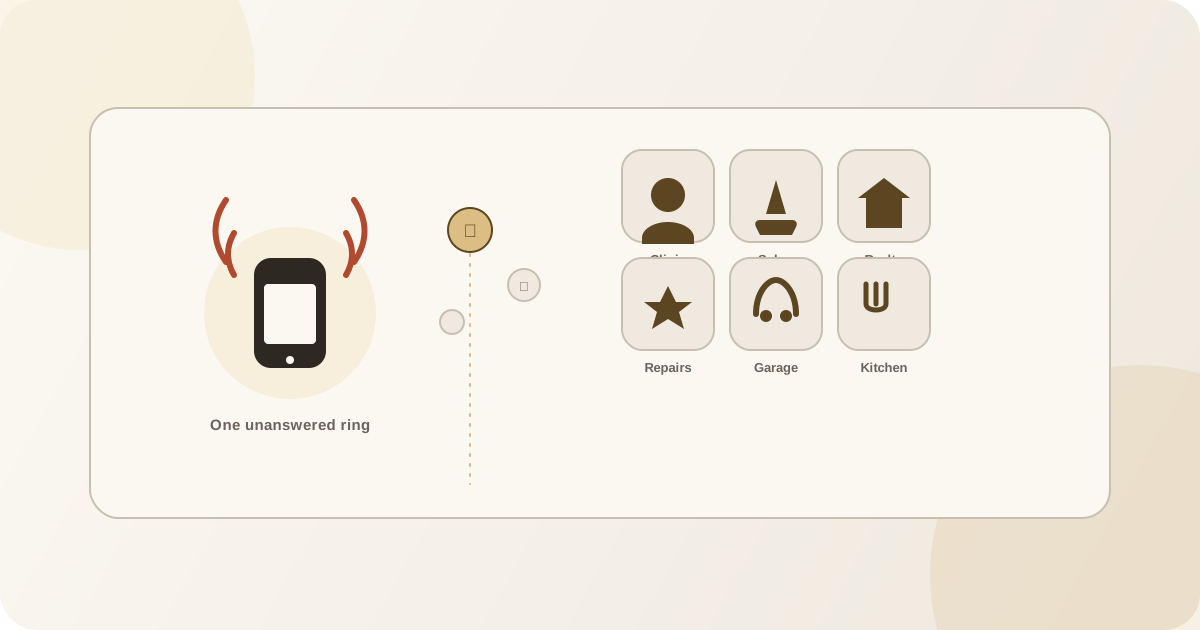
A missed call does not feel like a loss. Nothing crashes, nothing shows up on a balance sheet, and the phone stops ringing before anyone has time to think about it. That is exactly why it is easy to underestimate.
Most small businesses can tell you their rent, their staff costs, and their electricity bill down to the rupee. Very few can tell you how many calls went unanswered last month, or what those calls were worth. This post is a way to find out — a simple framework, applied to six kinds of businesses that all depend on the phone.
The quick math
The cost of a missed call comes down to four numbers:
- How many calls you miss in a week — during lunch, after hours, when the front desk is busy with a walk-in, or when two calls come in at once.
- How many of those calls would have converted into a booking, a job, or a sale, had someone picked up.
- What that booking is typically worth, either as a single visit or across a customer's lifetime with you.
- What happens to the caller instead — most people do not leave a voicemail. They call the next name on their list.
Multiply the first three, and you get a weekly figure. It is rarely dramatic on its own. It is the number you multiply by fifty-two weeks — and by however many years that customer might have stayed — that tends to change how people think about their phone line.
Dental and medical clinics
Clinics tend to lose calls in two predictable windows: while a dentist is mid-procedure and the front desk is unattended, and after closing, when a patient in pain is looking for anyone who will pick up.
A worked example. Say a single-chair clinic misses 15 calls a week — a mix of new-patient enquiries and existing patients trying to reschedule. If even 40% of those calls would have converted into a booked visit, that is 6 missed bookings a week. At an average first-visit value of ₹3,000 for a consultation or cleaning:
- 6 bookings × ₹3,000 = ₹18,000 a week, or roughly ₹72,000 a month, in first-visit revenue alone.
That figure does not include what a patient is worth over several years of check-ups, cleanings, and referrals — which is usually a much larger number than the first visit suggests. It also does not include the patient who called in pain, could not reach anyone, and is now a patient at a different clinic.
Salons and spas
Salons see the opposite pattern to clinics: call volume spikes exactly when staff are busiest, because a full appointment book means a full front desk too.
A worked example. A neighbourhood salon missing 20 calls a week, with a 50% booking rate on the calls that do get answered, is losing roughly 10 bookings a week. At an average service value of ₹800:
- 10 bookings × ₹800 = ₹8,000 a week, or about ₹32,000 a month.
Salon customers also tend to be habitual — someone who cannot get through once often just picks a different salon for every visit after that, not only the one they were calling about.
Real estate agencies
Real estate is a different shape of problem. The value per call is much higher, but the number of calls that ever convert is much lower — most enquiries are early-stage browsing, not a ready buyer.
The bigger risk in this industry is not the size of any one missed call, but its timing. A buyer who is calling about a listing is almost always calling two or three other listings the same afternoon. Reaching them first is often more predictive of a closed deal than anything about the property itself.
A worked example. An independent agent handling 10 property enquiries a week, missing 3 of them, is not just losing 3 calls — they are effectively handing those 3 leads to whichever agency answers first. At a typical commission of ₹1,50,000+ per closed sale, even a single one of those calls converting elsewhere is a meaningful loss, even though the arithmetic per call is harder to pin down than in a clinic or salon.
Home services
Electricians, plumbers, and AC technicians deal in urgency. A customer with a burst pipe or a dead air conditioner in July is not calling to browse — they are calling to get someone there today, and they will call the next number if the first one does not answer.
A worked example. A two-technician home-services business missing 12 calls a week, with a 60% booking rate given how urgent these calls usually are, loses about 7 jobs a week. At an average job value of ₹1,200:
- 7 jobs × ₹1,200 = ₹8,400 a week, or roughly ₹34,000 a month.
The follow-on cost is also higher here than in most industries: an unanswered emergency call is one of the fastest ways to lose a customer permanently, because the next provider they find is the one they will call again next time, too.
Auto repair garages
Garages combine both problems above — urgency, and a wide spread in ticket size between a quick service and a major repair.
A worked example. A small garage missing 8 calls a week, converting 45% of answered calls into a booked repair, loses about 3.6 jobs a week. At an average ticket of ₹4,000:
- 3.6 jobs × ₹4,000 = ₹14,400 a week, or roughly ₹57,000 a month.
A garage's real exposure is usually a handful of high-value repairs that never got called back rather than the average ticket — one missed call for a gearbox job can be worth more than a dozen oil changes.
Restaurants
For restaurants, the phone carries two very different kinds of calls: reservations and takeaway orders, which are individually small, and catering or large-party bookings, which are not.
A worked example. A mid-sized restaurant missing 25 calls a week during peak hours, where 30% are reservation or bulk-order enquiries and half of those would have converted, loses roughly 4 bookings a week at an average order value of ₹2,000:
- 4 bookings × ₹2,000 = ₹8,000 a week, or about ₹32,000 a month — before counting the occasional catering enquiry that is worth many times that on its own.
Why it compounds
None of the numbers above are dramatic in isolation. What makes them add up is three things that apply across every industry above:
- It is rarely a one-off. A business that misses calls during lunch misses them every day during lunch. A weekly figure becomes a monthly one, then an annual one, without anyone deciding that it should.
- The caller usually does not wait. Most people do not leave a voicemail and wait for a callback. They call the next business, and if that one answers, the relationship starts there instead.
- It is invisible by default. A lost sale from a bad review or a lapsed customer is at least visible somewhere. A missed call leaves no record at all, unless something is specifically tracking it.
What you can actually do about it
There is no single fix, and the right one depends on why calls are being missed in the first place.
- If it is a staffing gap — lunch hours, after closing, weekends — the options are extending hours, adding staff for those windows specifically, or routing those hours somewhere that can actually help the caller rather than sending them to voicemail.
- If it is a volume problem — two calls at once, a front desk that is also doing five other things — the fix is less about hours and more about having a second line of coverage that can pick up when the first one can't.
- If it is after-hours entirely, a voicemail greeting rarely closes the gap. Most callers with an urgent need move on rather than wait for a callback, which is the exact group of callers a business can least afford to lose.
A voice agent is one way to close these gaps without adding headcount — it can pick up every call, book the appointment or job directly against a real calendar, and text a confirmation afterward, in whichever language the caller starts in. It is not the only answer, and it is not free of its own tradeoffs, which is worth reading about in Voice Agent vs IVR if you are comparing options.
Whatever the fix, the first step is the same one this post started with: work out what a missed call is actually worth to your business specifically, using your own call volume and your own numbers. For most small businesses, that number is larger — and more consistent — than it first appears.